

Unlock Deep Understanding: A Step-by-Step Guide to the Feynman Technique
Today, we will take a look at the Feynman Technique, a critical mental model for note taking
The “Illusion of Knowing” (And How to Beat It)
Have you ever finished reading a dense chapter in a textbook, your page covered in highlighter, only to realize an hour later that you can’t explain the core concept? You recognize the terms, but you can’t articulate what they mean or how they connect.
This is a frustrating, universal experience for active learners. It’s called the “illusion of competence”—a cognitive bias where we mistake familiarity for true understanding. Passively re-reading or highlighting gives us this false sense of security, but it’s one of the least effective ways to learn.
What if there was a way to test your knowledge in real-time? A method that acts like a spotlight, instantly revealing the fuzzy edges of your understanding and forcing you to build a foundation of real, durable knowledge?
There is. It’s called the Feynman Technique, and it’s one of the most powerful mental models you can add to your learning arsenal. This post, the first deep dive in our series on mental models, will show you exactly what it is, where it came from, and how to apply it to your note-taking to truly master any subject.
What is the Feynman Technique?
The Feynman Technique is a mental model designed to build deep, genuine understanding of a concept by explaining it in simple, plain language.
The entire technique is built on a single, powerful premise:
“If you can’t explain it simply, you don’t understand it well enough.”
Instead of just memorizing facts, the technique forces you to actively process information, break it down, and reconstruct it in your own words. It’s not a study “hack”; it’s a diagnostic tool that ruthlessly exposes your knowledge gaps and a construction tool that helps you fill them. By pretending to teach the concept to a beginner (like a child or a fellow student), you quickly discover where your logic breaks down and where you’re just “parroting” jargon you don’t fully grasp.
Its Origin: The Scientist Who Taught Simply
This model is named after Richard Feynman, a Nobel Prize-winning physicist. Feynman wasn’t just famous for his work in quantum electrodynamics; he was legendary for his ability to distill staggeringly complex ideas into simple, intuitive, and accessible analogies.
Feynman had a deep disdain for jargon and superficial knowledge. He believed that if you truly understood something, you could strip away the complex terminology and explain the core idea in a way anyone could understand. This technique was his personal method for confronting complex subjects, testing his own knowledge, and ensuring he wasn’t fooling himself.
How to Apply the Feynman Technique to Your Note-Taking
This is where the magic happens for active learners. You can transform your note-taking from a passive act of transcription into an active process of deep learning. Here is the step-by-step process.
Step 1: Choose Your Concept & Take Your First Notes
First, pick the concept you want to learn. Go through your source material—books, lectures, articles—and take your initial set of “messy” notes. This is your raw data. Don’t worry about structure yet. Just capture the key information, definitions, and examples as you see them.
Step 2: Explain It Simply (The “Blank Page” Test)
This is the most critical step. Do not re-read your notes.
Open a brand new, blank page or note. At the top, write the name of the concept. Now, pretend you are teaching this concept to someone who has never heard of it before.
Write out your explanation from scratch.
- Use your own words. Do not quote the source material.
- Avoid all complex jargon. If you must use a technical term, you must be able to explain it in simple terms immediately afterward.
- Use analogies and examples. Compare the new concept to something simple and well-understood.
Step 3: Identify Your Gaps
This is the “diagnostic” part of the process. As you write your simple explanation, you will inevitably get stuck. You’ll hesitate. You’ll realize you’re not sure how two ideas connect, or you’ll find yourself having to use a fancy word because you don’t know what it actually means.
These points of failure are the entire goal. They are red flags pointing directly to the gaps in your knowledge.
This is where you go back to your source material and your messy first notes. Re-read, re-learn, and fill in that specific gap until you can explain that part simply, too.
Step 4: Review, Simplify, and Organize
Now, go back to your “simple” explanation note. Read it out loud. Does it sound confusing? Is it still too wordy?
Refine your language. Simplify your analogies. Structure the explanation in a logical flow, starting with the core idea and building upon it. The final output of this process is a new, golden note—a “Feynman Note”—that is concise, clear, and proves your understanding. This new note is infinitely more valuable than your original messy notes.
How to Apply the Feynman Technique Using Knowzy
The Feynman Technique requires a flexible space to think, write, and connect ideas. A basic, linear notes app can feel restrictive. This is where a dedicated thinking space like Knowzy becomes your “thinking lab” for applying this model.
Here’s how Knowzy’s features directly support this workflow:
- Step 1: Capture Raw Data Easily
- Use the Knowzy Chrome Extension to clip articles and research.
- Use the Transcription feature to turn lectures or videos into text.
- This builds your “messy” note library—the source material you’ll refer back to.
- Step 2: The Perfect “Blank Page”
- Simply create a new note in Knowzy. The clean, focused interface is the ideal distraction-free environment to start your simple explanation from scratch.
- Step 3: Supercharge Your “Gap-Filling”
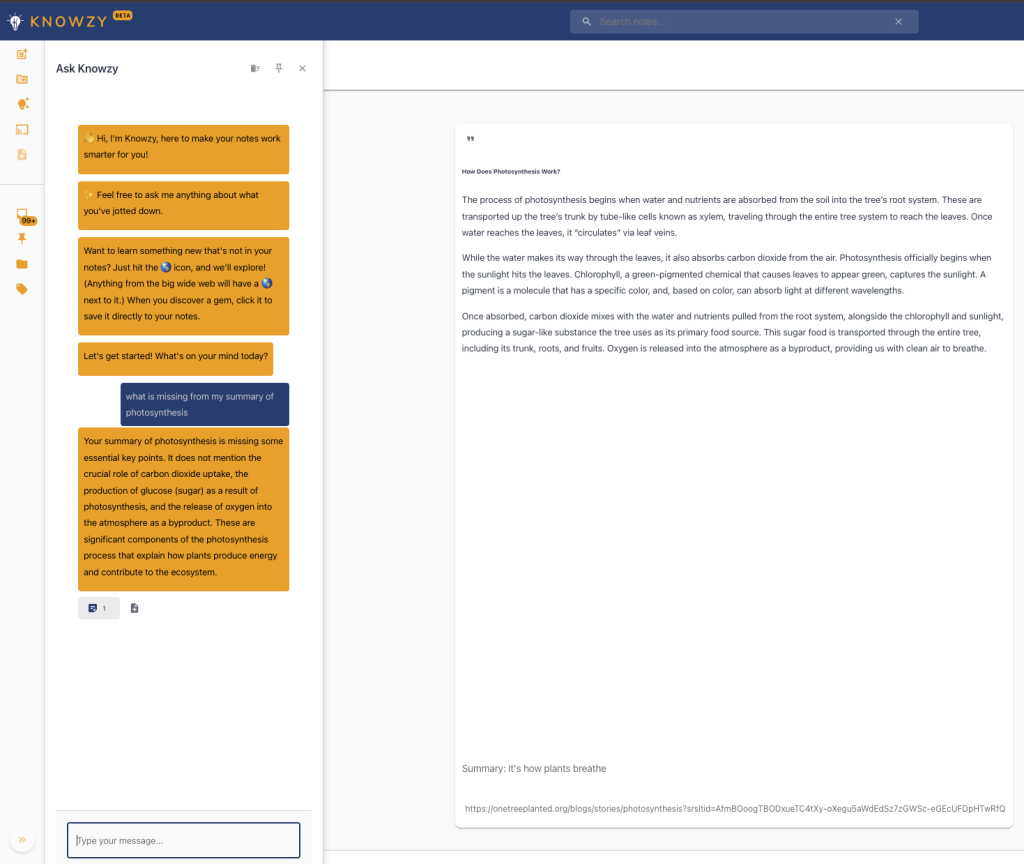
- This is where Knowzy’s AI accelerates your learning. When you get stuck on jargon (Step 3), you don’t have to leave the app.
- Highlight the complex term in your original note and use the Ask Knowzy AI to say: “Explain this simply” or “Give me an analogy for this.”
- This AI-powered feedback loop drastically cuts down the time it takes to fill your knowledge gaps.
- Step 4: Structure Your Final “Feynman Note”
- Use Flexible Blocks: Don’t just write a wall of text. Use Knowzy’s flexible block-based structure to visually organize your simple explanation. Create a main block for the core concept, then add separate text blocks below for each simple definition and analogy. You can use comments within blocks to refine your thoughts as you go.
- Speak Your Explanation: Use the Transcription feature in a new note. Literally speak your simple explanation out loud. The app will transcribe it, and you can review the text to see if it makes sense. This is the most literal application of the “teaching” step.
- Connect Your Notes: Once your “Feynman Note” is complete, link it back to your original source notes. This creates a powerful connection between the raw data and your new, deeply processed understanding, building a true second brain.
Conclusion: Stop Memorizing, Start Understanding
The Feynman Technique is a powerful mental model that shifts you from being a passive collector of information to an active builder of knowledge. It’s a continuous process, not a one-time trick.
By practicing this technique, you learn to identify the fuzzy boundaries of your knowledge, fill those gaps, and construct a durable, deeply-rooted understanding.
Your note-taking app shouldn’t just be a place to store information; it should be the environment where you do this critical work. It should be your partner in the process of turning chaos into clarity.
This is the first of our deep dives into the mental models that can transform how you learn. Stay tuned for our next post in the series.
Ready to stop memorizing and start understanding? Visit knowzy.ai to get started!
